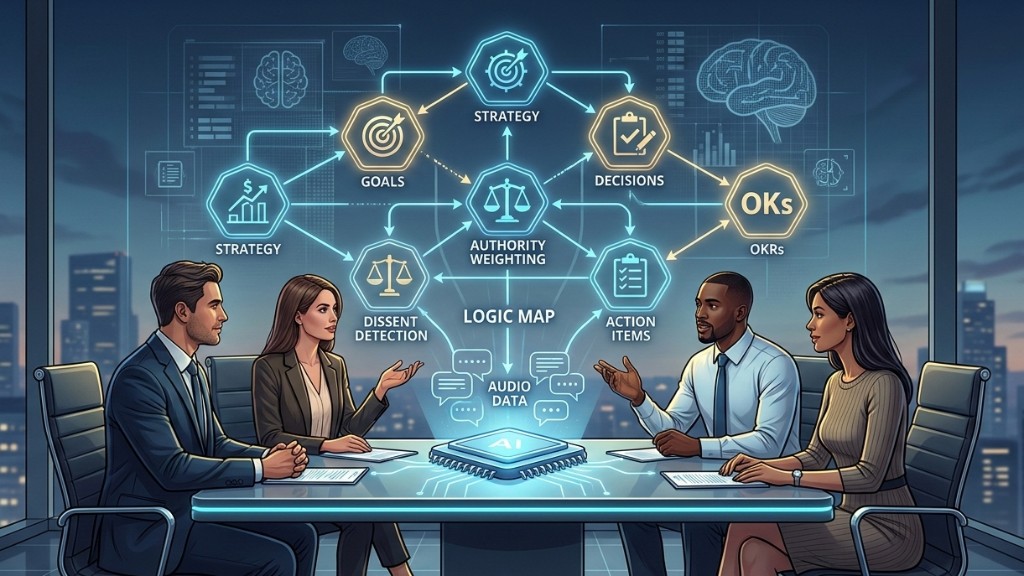
Senior executives spend an average of 23 hours per week in meetings — a figure that has nearly tripled since the 1960s. But the real productivity drain isn't the meetings themselves; it's the invisible labor that follows: writing summaries, distributing notes, chasing missing context, and aligning stakeholders who couldn't attend. AI meeting assistants are eliminating this entire layer of overhead.
The Hidden Cost of Manual Note-Taking
Most organizations underestimate the true cost of meeting overhead. A Harvard Business Review study found that executives spend an additional 30-45 minutes per meeting on post-meeting tasks: writing up notes, formatting minutes, sending follow-up emails, and tracking action items. For someone with 8 meetings a day, that's an extra 4-6 hours of invisible work — every single day.
Worse, manually captured notes suffer from fundamental problems:
- Selective memory bias — Note-takers unconsciously filter information through their own perspective, missing context others would consider critical
- Attention split — You can't fully participate in a discussion while simultaneously documenting it. Research shows note-takers retain 40% less information from conversations
- Inconsistency — Different people in the same meeting produce wildly different summaries, creating organizational confusion
- Latency — Notes shared hours or days after a meeting lose urgency and context. Decisions drift, action items get forgotten
1. Reclaim Full Presence in Every Meeting
The most immediate benefit of AI meeting assistants is deceptively simple: you can stop taking notes. This isn't a minor convenience — it fundamentally changes how you show up in conversations.
When you're freed from the mechanical task of transcription, you can:
- Listen for nuance and subtext rather than just surface-level words
- Ask deeper follow-up questions that drive better decisions
- Read body language and emotional cues that signal disagreement or uncertainty
- Contribute more meaningfully instead of context-switching between writing and thinking
Organizations that deployed AI Minute Note across their leadership teams reported a 34% improvement in meeting decision quality within the first quarter — largely because participants were finally fully present.
2. Transform Post-Meeting Chaos into Instant Output
The traditional post-meeting workflow looks something like this: attend meeting → jot rough notes → later clean up notes → write summary email → identify action items → send follow-ups → hope everyone reads them. This process takes 30-60 minutes per meeting and often happens hours later, when memory has already degraded.
With AI meeting assistants, the moment a meeting ends, you get:
- Structured meeting minutes with automatic section headers, key decisions highlighted, and a clear narrative flow
- Action items with owners — AI identifies who committed to what, with suggested deadlines based on the conversation context
- Speaker-attributed transcripts — Every statement is linked to the person who said it, eliminating "who said what?" ambiguity
- Sentiment insights — Flagging moments of disagreement, hesitation, or strong consensus that might influence next steps
3. Build a Searchable Corporate Knowledge Base
Perhaps the most transformative — yet least discussed — benefit of AI meeting assistants is the compounding knowledge asset they create over time. Every meeting you record becomes a permanent, searchable record of organizational intelligence.
Think about the questions that haunt every growing organization:
- "When did we decide to change the pricing model?" — Search it
- "What concerns did the legal team raise about the partnership?" — Search it
- "Who was responsible for the Q2 hiring plan?" — Search it
- "What was the original reasoning behind our pivot to enterprise?" — Search it
Without AI, these answers live in scattered notebooks, forgotten Slack threads, and the unreliable memories of people who may no longer be at the company. With a proper meeting intelligence system, they're indexed, cross-referenced, and instantly retrievable.
4. Eliminate the Async Information Gap
In today's globally distributed teams, not everyone can attend every meeting. The traditional solution — someone writes a recap and shares it — creates a lossy information channel. The recap is filtered through one person's perspective, arrives hours late, and lacks the nuance of the original conversation.
AI meeting assistants solve this by providing:
- Full transcripts with timestamps — Team members can read or skim the exact conversation, not someone's interpretation of it
- Multi-language summaries — AI Minute Note supports 99+ languages, automatically generating summaries in each team member's preferred language
- Contextual highlights — AI identifies the 3-5 most critical moments in a meeting, so async participants can jump directly to what matters
The 10-Hour Equation
Let's do the math for a typical knowledge worker with 6-8 meetings per day:
Even conservatively — accounting for meetings that don't need detailed notes — most professionals report saving 2-3 hours per day, or 10-15 hours per week. That's an entire extra workday, every week, returned to strategic thinking, creative work, or simply going home on time.
Getting Started
The best part? You don't need IT approval, complex integrations, or organizational change management. AI Minute Note works on your personal device — open the app, tap record, and let AI handle the rest. Your first meeting summary is free, and it takes less than 60 seconds to understand why going back to manual notes would feel absurd.
Ready to Reclaim Your Time?
Join thousands of professionals who never take notes by hand anymore. Download AI Minute Note — free forever plan, no credit card required.