First-generation meeting AI answered a simple question: "What was said?" The next generation answers a far more valuable one: "What was meant, who held power, and what should happen next?" This shift — from transcription to strategic interpretation — is transforming how the world's best teams operate.
Beyond Transcription: The Three Layers of Meeting Intelligence
A raw transcript is just text — the same way raw data is just numbers. The value emerges from the layers of interpretation that AI applies on top of the spoken word. Modern meeting AI operates across three distinct intelligence layers:
Layer 1: Semantic Architecture
When three different people say "we should be careful about costs," "the budget is tight," and "let's not overspend this quarter," a human instantly recognizes these as the same strategic concern. Traditional keyword search would treat them as three separate statements. AI semantic analysis links them into a single strategic theme — fiscal caution — and tracks how that theme evolves throughout the meeting.
This capability enables what we call theme mapping: a visual representation of the 4-6 core themes that dominated a meeting, their relative weight (how much airtime they received), and how they interconnected. A CEO reviewing a quarterly planning meeting can see at a glance that "hiring concerns" consumed 40% of the discussion and was linked to both "budget" and "product timeline" themes.
Layer 2: Sentiment and Authority Weighting
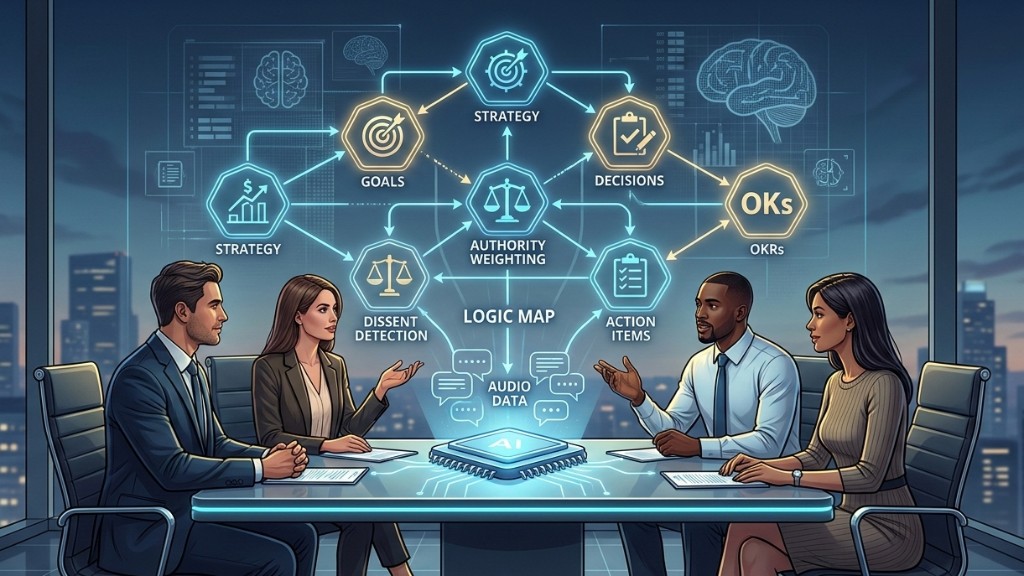
Not all agreement is equal. When a junior analyst says "I think that's a good idea" and the CFO says "I think that's a good idea," the organizational impact is completely different. AI meeting intelligence systems now factor in:
- Speaker authority signals — Detecting who drives the conversation versus who follows. This isn't just about title — it's about linguistic patterns like interruption frequency, topic-setting behavior, and whether others reference their statements
- Confidence markers — Distinguishing between "We should definitely do this" and "We could maybe explore this" to weight the strength of consensus
- Hesitation detection — Identifying moments where speakers pause, qualify their statements, or use hedge words — signaling uncertainty that the surface text doesn't reveal
- Dissent tracking — Flagging when disagreement is expressed subtly (tone, phrasing) rather than explicitly, which often indicates the most important strategic tensions
Layer 3: Logic Extraction Pipeline
The most sophisticated layer of meeting AI transforms raw dialogue into structured decision logic. This pipeline produces multiple output formats, each serving a different organizational need:
- Transcript — Full speaker-attributed text with timestamps, searchable and referenceable
- Summary — A 200-300 word narrative capturing key themes, decisions, and outcomes
- Action log — Specific commitments extracted with owners, deadlines, and context links
- Decision register — A formal record of what was decided, the alternatives considered, and the reasoning behind the choice
- Risk flags — Issues raised but not resolved, commitments made without clear ownership, and topics that were avoided
From Meeting Records to Strategic Assets
When meeting intelligence is captured consistently over time, something remarkable happens: patterns emerge across meetings that no individual participant would notice.
Consider these strategic questions that become answerable with longitudinal meeting data:
- "Over the last quarter, has our leadership team's confidence in the product roadmap increased or decreased?" — Sentiment trend analysis across 50+ meetings
- "Which strategic concerns raised in January were never addressed in subsequent meetings?" — Theme gap analysis
- "When we make decisions quickly, are the outcomes better or worse than when we deliberate?" — Decision quality correlation
- "Which team members consistently raise issues that later prove important?" — Strategic signal identification
This is the transition from meeting records to meeting intelligence as a strategic asset. It's analogous to the shift from keeping financial records (accounting) to using financial data strategically (business intelligence). The raw material is the same; the value extracted is exponentially higher.
Practical Applications Today
This isn't science fiction. Here's how teams are already using strategic meeting intelligence:
- Board preparation — CEOs use AI-generated theme maps from leadership meetings to prepare concise, evidence-based board presentations
- M&A due diligence — Deal teams review meeting intelligence from partner discussions to identify alignment gaps and negotiation leverage points
- Product strategy — Product leaders track how customer feedback themes evolve across dozens of customer calls, spotting trends before they become obvious
- Organizational health — HR leaders analyze meeting dynamics to identify teams with communication breakdowns or unresolved strategic tensions
Getting Started with Meeting Intelligence
The journey from basic transcription to full strategic intelligence is incremental. Start by recording your meetings consistently. AI Minute Note handles the entire pipeline — from audio capture to structured outputs — automatically. Over time, the compounding value of your meeting data becomes one of your most valuable organizational assets.
The barrier to entry is remarkably low. You don't need to change how you run meetings. You just need to start capturing them intelligently.
Start Capturing Strategic Intelligence
Transform your meetings from ephemeral conversations into lasting strategic assets. Download AI Minute Note and experience the difference.